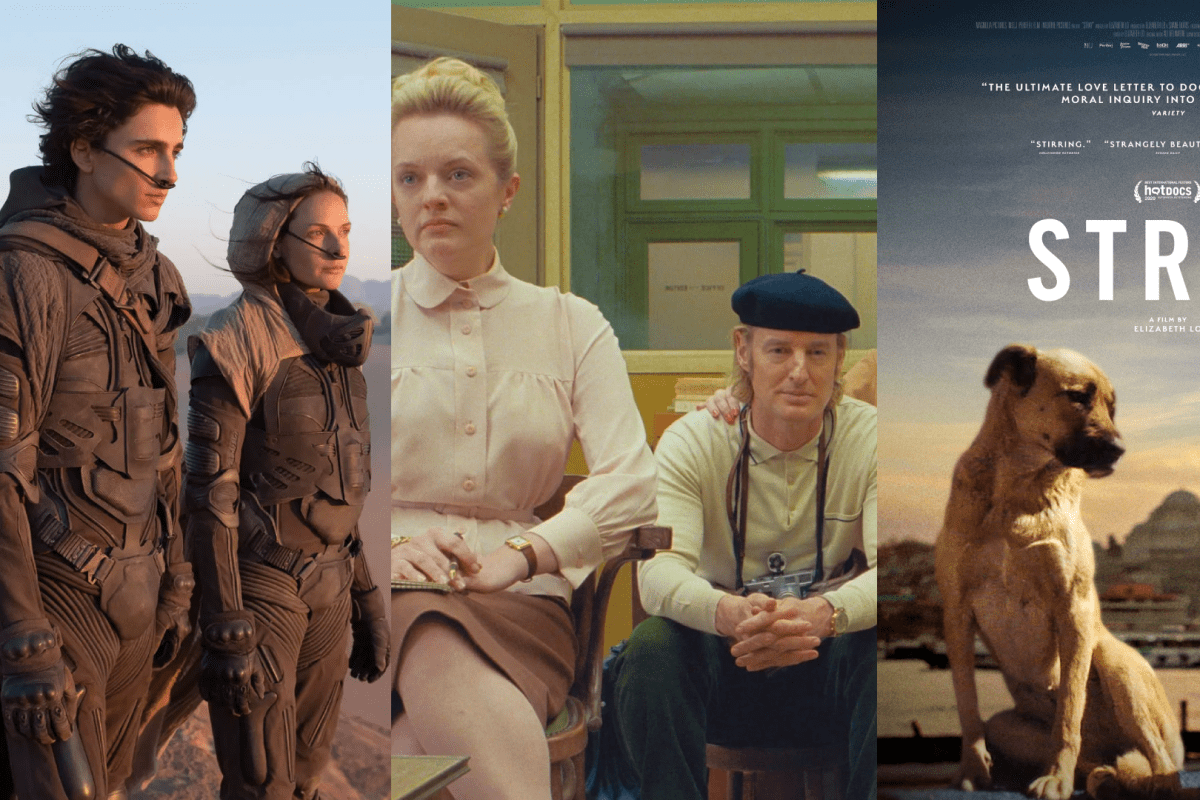
Review: Dune/The French Dispatch/Stray

Damn, this is a lot of movies. It really is rather worrisome right now. Each screen of a film I go to is slowly filling up again. More popcorn munchers returning. However, it’s good news for the cinemas I guess, so whatever. That said, most people have been code compliant and it’s been nice for the atmosphere.

Dune

You’ve probably seen Dune advertised as the new Lord of The Rings for the sci-fi age, and in some ways its comparable. Part 1 (the sequel has recently been confirmed) certainly doesn’t live up to LOTR, however it does provide an interesting viewing experience.

Paul is part of a pretty strong family called Atreides. The great emperor offers them the desert planet which everyone likes because it’s full of spice which is the commodity that has people queuing up at pumps as soon as someone says “shortage”. Paul has been having visions about a pretty woman who lives on the planet, mainly because his mother is a part of a cult, but screw that because it turns out the emperor is tricking Team Paul by planning to invade the desert planet he just gave away. Things happen, then we have a desert exploring story as Paul looks to see what his dreams about the pretty girl mean and use his loud voice which makes people do what he wants.

The plot is certainly dense. After 2.5 hours I found myself running out of energy trying to keep track of the moving parts and certainly a fan of the book would get more out of a first watch, although that said I think a second watch would be easier.

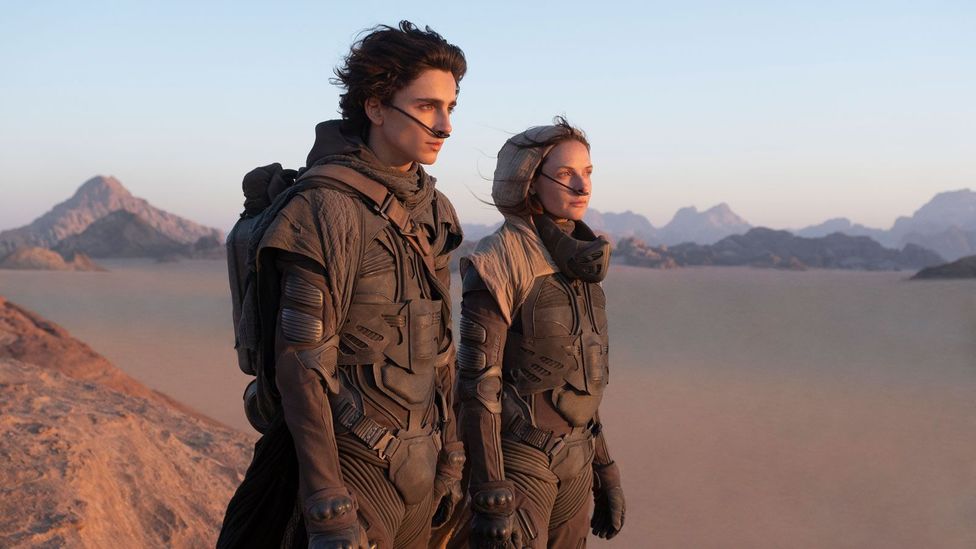
Aside from that, Aunt and I went to see the film in the big fancy Dolby screen in Leicester Square (The one where all the previews happen) and it was a brilliant experience. This is a film which needs to be seen on a big screen and is the first true blockbuster we’ve had since 2019. The scenes were great and full of detail. The effects were big and the landscape, no matter how plain was hypnotic. The whole film had an entrancing feel and really did give off big Star Wars vibes. The sound effects were also fantastic. The deep vibrations and explosions could be felt through your seat and it’s been so long since there has been a movie like that. If you can see it in a cinema, with IMAX, do so and you won’t be disappointed in this visual treat. The ships and especially the giant worms were all wonderful to look at and really had a great sense of scale.

However, you might be disappointed in the story. For such a big source material, it is difficult to get everything right, think of the original Dune or even Akira and the world was tough to understand, although that wasn’t helped. Any prophecy or vision was randomly littered when it occurred. It would have been so much better to have any cultish prophecies near the start, then we would have had a brilliant pay-off.
Four stars for Dune - BBC Culture

My biggest gripe however, was the ending. Obviously, I won’t spoil anything here, but I was starting to get tired, then thought that we were finally about to get somewhere, however we didn’t. There was one anti-climatic moment of combat in which the hero didn’t even look like they were in danger, then 30 seconds later we just ended. There was no pay-off from this lame moment, it just finished. I know some people don’t like the Fellowship of the Ring ending, but that seemed like a nice wrap up compared to what I saw.

The good news however, is that this film has a solid footing for a good sequel. It’s built a rich world with some interesting threads and certainly suggests part 2 will be much darker and more adventurous. If the soundtrack is anything as good as this one was (Hans Zimmer was brilliant), and the acting remains competent then we’re in for a treat.

Summary

Dune is a really solid blockbuster movie. With big visual and sound effects and a wonderful soundtrack, this film should be seen on as big and loud a screen as possible, and it will make up for some story issues which certainly stopped it from being deserving of legendary status. [Grade: B]

The French Dispatch

There seems to be a stereotype that when I like a film, it’s probably pretentious twaddle. Maybe the stereotype is that I actually like pretentious twaddle among other films. I very much assure you this is not the case and can confirm this as I didn’t really like The French Dispatch because it was pretentious twaddle.

The film isn’t really a movie, but an anthology of three stories all linked by them being written for the French Dispatch, a magazine for people who don’t like comics. This is linked by some narrative about the editor dying, but that really isn’t important. The first story is about a homicidal maniac who is a talented artist told by Tilda Swinton’s character. It’s a bit slow and doesn’t really give much, The second story is about a student protestor who protests and writes a manifesto. he’s a bit pretentious and unlikable, a perfect metaphor for this movie. The third is about a child been taken hostage and a cook having to save him. Again, nothing really big there.

I don’t care and neither should you because the huge problem with the French Dispatch is that it has no heart. Each story and character is there briefly until they’re not. Each speak in a way that makes them sound like intellects. Your new French wave film lover will love it because the character sounds like them, but that’s because they kind of sound like [I’ll allow you to choose your own insult here].

Wes Anderson's 'The French Dispatch': release date, plot, cast and  everything we know

The film is pretty, it’s well shot and is nice to look at. It doesn’t have the grandeur of Grand Budapest Hotel, but it’s much more varied and experimental. The problem here though is that it doesn’t really do any of these techniques for a reason, except to show it can. It sounds good and occasionally leaves a wry smile. It’s too quirky and Wes Anderson forgets how to make a movie.

Summary

The French Dispatch is a very nice looking movie made in Wes Anderson’s trade mark style. Lovers of his movies will gain a lot out of it, however the rest of the world should avoid this nonsense and actually watch something enjoyable. [Grade: D+]

Stray

I also wanted to quickly mention Stray. It had it’s cinema outing earlier this year and I missed it then, however it is now out on BFI Player and other streaming platforms. It’s going to sound like pretentious nonsense, but I like pretentious nonsense.

Turkey is one of very few countries where it is illegal to capture or kill a stray animal. This means cities such as Istanbul, where the film takes place, have loads of stray dogs wandering the streets. Stray is a documentary which follows one dog, Zeytin, around the city documenting his life with no voice over or anything and it’s really brilliant.

I know animal lovers will be apprehensively concerned about this film, but I can assure you that no dogs are harmed during the run time. Zeytin is a beautiful soul who we come to know and love. She doesn’t look to hurt anyone and is friendly with dogs and humans alike. The film is shot without a voiceover, meaning you are just seeing her and watching her face to connect with her. It is also shot often at dog head height meaning you often see humans from the waist down giving you Zeytin’s perspective.

The film gets even stronger when half way through you meet three Syrian refugees who Zeytin essentially lives with. They’re the ones who named her and she goes around with them regularly. They’re in a state of limbo, unable to work and regularly just sniffing glue to pass the time. It’s somewhat poetic as these humans are as lost and stray as Zeytin and much like her just want a sense of love and belonging. From that, we can compare the way refugees are treated to that of animals, and it really doesn’t come out well.

As well as looking great, there is a beautiful violin soundtrack which gives these streets a sense of magic, wonder and grandeur which fully immerses you.

Summary

Stray may be one of the most simple, but one of the best documentaries of the year. It just follows one dog around with little context who you immediately care for and her friends. It shows a snapshot of Istanbul politically in the background as a consequence making it an enjoyable film about a dog and a thought provoking piece of art. [Grade: A-]

The Invisible Life of Euridice Gusmao (18)

I know, I went quiet again. The simple reason is that after James Bond, there wasn’t much on, although I did go to London Film Festival a couple of times. I saw Red Rocket, Sean Baker’s new film after The Florida Project (one of the best of the last 5 years) which was disappointing, Pedro, a film about someone in India killing a cow (I didn’t really get what was going on) and Hit The Road, which actually won best film at LFF. I enjoyed that one and look forward to re-watching when it’s released next year. Surbiton Rebel Wilson Fan Club didn’t enjoy LFF as it had competent actors in it. Still, before I watch Dune and the French Dispatch, I just wanted to discuss this film I randomly caught last week.

Set in 1950’s Brazil, Invisible Life looks at two sisters called Euridice and Guida who when we meet them are in their late teens. Euridice is a quiet, incredibly gifted pianist who dreams of play in Vienna, while Guida is much more of a free spirit. Both love each other dearly. One day, Guida asks Euridice to help her escape to a party. Much to Euridice’s surprise, Guida runs off that evening with a man to Greece. Euridice marries a Brazilian man some time later, having not heard from Guida. All seems calm until Guida comes back to Rio De Janiero pregnant. The father is outraged and banishes Guida, falsely telling her that Euridice has moved to Austria to pursue her dream, while Euridice is none the wiser, still believing that Guida is in Greece.

At this point, the two miss each other very much. Euridice is regularly asking her parents about whether they’ve heard from Guida, while Guida regularly sends letters home, although none ever reach Euridice. They both imagine the other out in Europe living their dream, while the reality is that both are in Brazil, not living the dreams and being stifled by the world around them.

The film really reflects the rampant sexism of the time in a brutal manner. Both women are limited and hurt by those around them. Euridice’s dream is quashed by her husband in the same way that Guida’s happy ending is ruined by the Greek man who has left her to be a single mother. Their father is stopping their loving relationship while their mother is described as his shadow. Most of the dialogue throughout shows this theme as do the sex scenes which show how the men have all the power. Despite the world beating them down, however, the relationship between Euridice and Guida is never fleeting as they love each other and want nothing more than to be back together. Nowhere is this clearer than in the film’s final act which is one of the strongest of the year and left me an emotional state.

The main way it did this was through a simple and engaging plot and good story telling. The script is a tight one, with each new scene showing quite a lot of progress. After the first 20 minutes, there is no filler, no time to breathe and reflect. You’re on this journey, potentially hopping forward years at a time, following two complex and fleshed out characters, praying for their reunion.

Invisible Life (2019) - IMDb

The whole film really kept me intrigued in its almost 2.5 hour run time. The cinematography wasn’t particularly special, as the film was very indie, but that’s fine. The characters are so much more important than any special effects. They make it authentic, so much so that some of the more melodramatic moments forgivable, and rather emotional. I did shed some tears at some point in this movie. Any sadness and fear is matched by community. When Guida is banished from her house, the film risks becoming some form of “poverty porn”, however what it does instead is see her befriend another woman and rely on this community, offsetting that with Euridice’s more depressing but conventionally successful life with her not very supportive family network.

The film does something really interesting when entering a new time period by having it introduced with Guida’s voice reading the letters she sends to Euridice. This technique in particular doesn’t go with the show don’t tell mantra, however it does effectively show time passing and despite the hardships going on in Guida’s life, it shows how much she still cares for her sister.

I also want to give a quick shout out to the wonderful score by Benedikt Schiefer. It’s quite understated at times, but dominant at others. It sticks to classical instruments, especially the piano which reflects Euridice’s life. The more fantastical naturalistic parts of the score also leave you in a bit of a trance.

Summary

The Invisible Life of Euridice Gusmao isn’t for those faint of heart, however away from the more disturbing scenes, there is an absolutely brilliant story of two sisters who love each other and want nothing more to be reunited. While subtly looking at power and sexism themes, the tight writing and acting lead to a really emotional story which is one of the best of the year. [Grade: A]

This film has a very limited cinema run, but it also available to stream

Review: No Time To Die

No Spoilers

There are two ways in which I could watch James Bond. Either I am a secret agent who will critique the accuracy of the spy world with expertise, or I am not a secret agent and I will critique the spy world without expertise. The paradox here is that if I am a secret agent, I will not divulge this and in fact tell you I am not a secret agent, and appear to critique without expertise. The point of this opening paragraph? To say I’m not a secret agent.

I have never really bothered with Bond before. I’ve seen most of Skyfall in parts, and watched Judi Dench die for some reason, but otherwise it’s just never had a good time to jump in, and honestly NTTD may not be the best time for a new bond fan to jump in, but it’s literally the only thing on in the cinema this week so who cares.

The general story is one I’m sure I’ve heard somewhere before. Opening couple of scenes are flashbacks, one with a girl who sees her mum shot by a bad guy with a mask, the second has Mr Bond in Italy with a woman he likes, before they are found by Spectre, the bad guys. He accuses her of betraying him. We then go five years later where Bond is hidden away retired, however when a mysterious and deadly weapon goes missing, he has to hunt it down before the villain can cause major damage. Alongside his usual alphabetti spaghetti friends and a brand new double-0, James Bond will try to save the world with the suave and panache of this film series.

So I don’t really know where to start with this as I simply don’t know Bond that well, but I guess I will tell you that I enjoyed it. On the whole, the film remained serious, but with that tinge of camp charm that is so often included. You get your “shaken not stirred”, “Bond, James Bond” plethora of moments in amongst a serious attempt at a spy thriller and the occasional use of a kill line is more tolerable than the standard constant Marvel dross.

For Daniel Craig, it was a fitting swansong. This loner starts to show his feelings and his hope and it’s a solid outing. It will certainly be odd to see who the next 007 will be as he is the only one my generation have grown up with. He has that serious suave that you know and are endeared towards and his successor will have a tough time trying to match Craig’s levels.

For every great hero there should be a great villain. Does Rami Malek’s Siffan provide a worthy adversary? No, he was boring. A generic eastern European mumbling accent and a scarred face to boot, Malek is really let down by a fairly shoddy script and doesn’t offer anything of interest either. A big name after Bohemian Rhapsody, maybe his best work is the indie-stuff and he should stick to that as with this role he has nothing. As well as being poorly acted, the character doesn’t bring much to the table either, with the reasons for his intentions never really explained. He wants to kill people just because. If the script had provided more reason for his character to act as he does, the emotional climaxes would have meant something and would have made a bit more sense than just slightly forced plot points, although if I knew more about Bond, maybe the main moments would have meant more to me.

Does No Time to Die bring back an iconic James Bond villain?

While there is a fairly standard formula, it is stirred, if not shaken. The last act has a few un-Bond-ly turns in it which were a genuine surprise. The addition of the new double 0 was a welcome change, and was well acted by Lashana Lynch. It will be interesting to see if she continues to play a significant role in the future.

At two hours and forty minutes, this is certainly one long film. It generally went rather quickly. At times, it felt slow, but I didn’t find myself bored. That said, it could have certainly streamlined twenty minutes as some scenes tended to feel somewhat repeated, with some American characters not particularly adding much. The moment Rami showed up, the whole thing seemed to slow down as well, when in reality we could have done with less droning from him. Still, on the whole these are minor complaints.

Summary

Craig’s final outing as Bond provides a solid, if not spectacular swansong. He enjoys a well crafted film, although it provides very little revolutionary ideas for film making. The potential impact of a strong last act is mitigated by an overly long run time, and an incredibly dull villain, but this doesn’t take away from a decent movie. [Grade: B-]