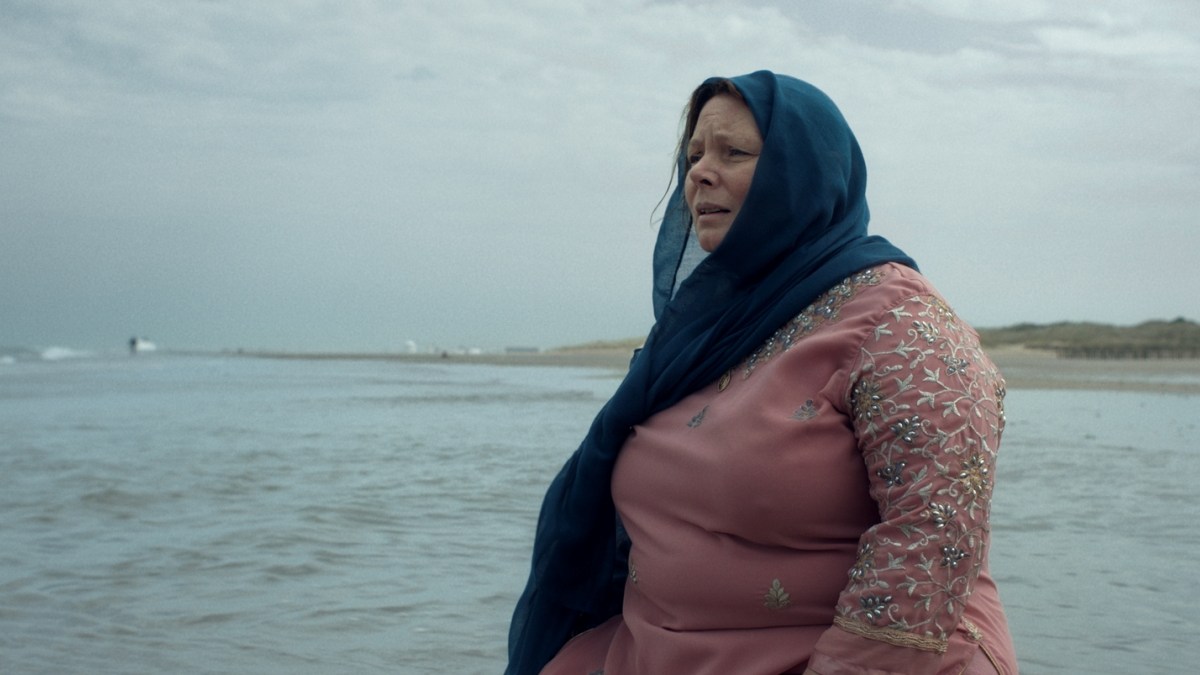
In most films, any character who is down on their luck can be given sympathy. Sympathy is the feeling of sorrow for somebody’s misfortunes. It’s easy to do and it’s easy for a film to generate that reaction. However, one level above that is the feeling of empathy, the ability to understand or share the feelings of another. About half way through this movie, lead character Mary texts a boy, pretending to be his dad. At this point, I quietly (in cinema code compliance) moaned “Oh no”. What she was about to do was morally awful and couldn’t lead to anything good. It would be easy to sympathise with her plight, however the film put together such a brilliant character, that you couldn’t help but empathise with her in this moment. You see what she’s doing and how it’s making her feel and you understand why, suffering with her and praying it will find her some relief. It takes a brilliant film to do that, and After Love certainly is that.
Mary (Joanna Scanlan) is a white Muslim woman who converted to the religion after marrying her husband Ahmad when they were fairly young. She’s been married to him for most of her life and suddenly he passes away. While having to deal with this grief, Mary looks at her husband’s phone and notices lots of texts to Genevieve, a woman living just across the English channel in Calais. She discovers that Ahmad had been living a secret life with another woman and a son that she didn’t know about. When she finds Genevieve, Mary becomes speechless, but assumes the role of the cleaner as she discovers than Genevieve is moving to England, presumably to be closer to the recently deceased Ahmad. The film focuses on Mary’s grief as she comes to terms with what happened, while also looking at her relationships with Genevieve and her son. This is all in secret as they have no idea who Mary is, nor that Ahmad passed away.
It seemed likely after the first ten minutes that the film would see Mary give up on religion and lose herself. However, her religion and family were all that she had, so for the film to take a far more humanistic approach were both more sensible and rewarding.
Even at 89 minutes, the film is quite a slow burner. There are long periods of silence and reflection. There are many artistic scenes. The camera will zoom in slowly on Mary, exaggerating her face while very little goes on around her. A dissonant violin makes an entry in the more artistic scenes as they represent Mary’s world collapsing in around her. There aren’t huge effects or a great score to keep your attention. However, it’s made up for in other ways.

The main reason this film is so brilliant is Joanna Scanlan. She is phenomenal in the role. There are long periods where she says nothing and only speaks with her facial expressions and body language. It is such an incredible skill to do so and she pulls it off fantastically, leaving you with no doubt about her emotions. Her chemistry with Nathalie Richard and Talid Ariss make their scenes all flow naturally, a pivotal part of a film which primarily looks at the relationships between the three.
The script is beautifully written and the film directed by Aleem Khan in her feature debut. There are respectful looks at identity and family as well as mourning. The script does a great job of releasing information at the right time throughout and passages of English, French and Urdu show differences between the three lead characters and their identities. The story really does focus on forgiveness and learning that you never truly know anyone.
Summary
By the end of After Love, I was emotionally drained and exhausted. Joanna Scanlon brought out a performance as good as any I’ve seen for a long time in this understated, deeply human portrayal of grief, forgiveness and identity. All of the characters execute this tight story in a professional, considered way. It’s essential viewing and up there with 2021’s best so far. [Grade: A]
 The Film Ramble
One thought on “Review: After Love”