
I actually write this review on 24th February 2021 not knowing when it will be posted. Maybe the film will be released in March as was claimed before a Boris Johnson roadmap. Maybe it’s now delayed until May for when the cinemas re-open. Who knows. In the time since, maybe I have been murdered by my new homicidal manic housemates (I move in 3 days time, so it’s a distinct possibility). Maybe I found a winning lottery ticket on the ground and am a millionaire. Maybe very little has changed, I still write this silly little blog, pretend I have imaginary beef with a fictional Surbiton based rival and have no life. God forbid.
What is certain is that I will still be a fan of Lee Isaac-Chung’s Minari. Set in the Reagan era, a family of first generation Korean immigrants move from Calafornia to Arkansas to make a fresh start. However, what most of the family, apart from Jacob, the father don’t realise is that their home is on wheels. Jacob has bought a big plot of land so that his family can make some money. Far away from a hospital or school, this decision hasn’t sat well with his wife Monica, who is very concerned about their son who has a heart murmur. Alongside the struggle to make the farm work in this small house, we see another story as the children’s grandmother moves in and we see a generational difference as she and her grandson struggle to connect as they basically come from different cultures.
This film was so brilliantly written, I don’t even know where to begin. The characters were mostly multi-dimensional and interesting. Stephen Yuen’s character Jacob was brilliant. His motivations for carrying on no matter how tough everything got were revealed with expert timing and Yuen gave another brilliant movie performance. The grandmother and grandson were both equally great, each one showing their similarities and differences. Their development over the course of the two hours was really intriguing and Youn Yuh-Jung’s acting as the film progressed was brilliant. The wife character was solidly played, however her character was there more as a motivation for Jacob than as her own entity. The daughter was ignored for the most part, having very few lines and very little purpose.
There is a constant focus on new beginnings, whether through the family’s jobs involving chicks or other symbolic gestures or moments. Identities play a strong part as well, considering how they are preserved as a result of immigration. The film keeps grounded in its approach. It doesn’t take any stereotypical tropes you might expect, like the “you’re not welcome here” american lines. Everyone wants one another to succeed in a refreshing, authentic way. Instead the struggles are within the family, whether Jacob trying to support his family or the family trying to get along.
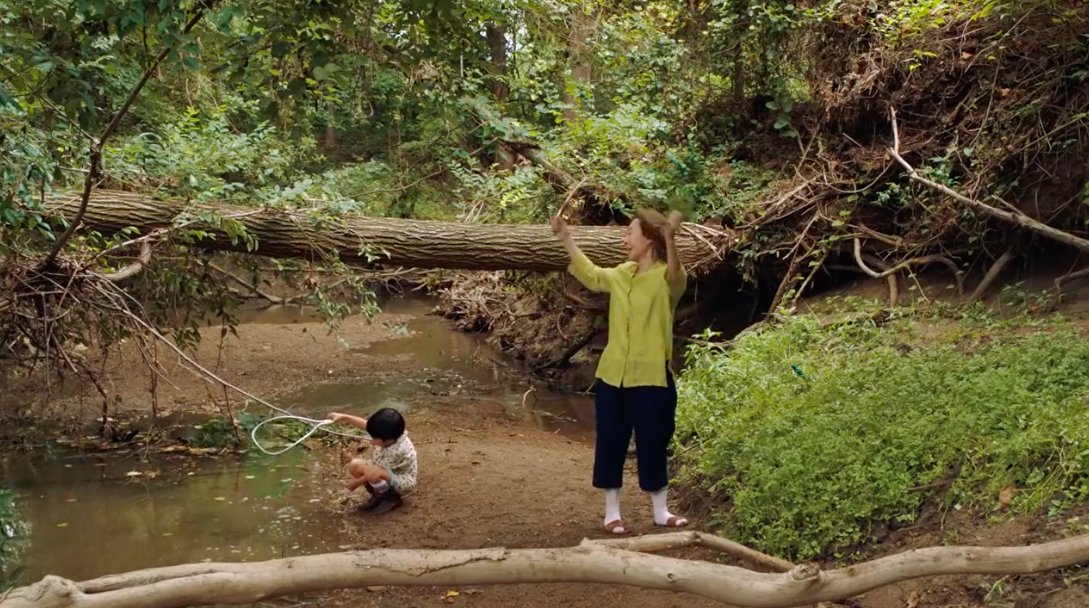
While the story is simple, it certainly is emotional. I laughed out loud at multiple points and at one point I was on the verge of tears. The family is immediately shown as lovely, meaning you wish for them all to succeed passionately from the first 10 minutes. The highs and lows are mixed in together. Whenever there is a happy moment, there is an equally sad one moments later, however the film is ultimately one of hope.
I must also give a great mention to the soundtrack. Put together by Emile Mosseri, this piano/choral mix was so hypnotic and almost dreamlike, reflecting the American Dream that the family are chasing. The film was brightly and naturally coloured keeping up the ideas of hope and the feeling of authenticity. The home felt small at first, however as everyone adapted it seemed to naturally open up. It was all put together brilliantly.
Summary
I can already guarantee that Minari will be one of the year’s best films. A brilliant authentic script and some great grounded performances elevate the film. A primarily understated character piece, this film truly is a masterpiece. [Grade: A]
 The Film Ramble
3 thoughts on “Review: Minari”